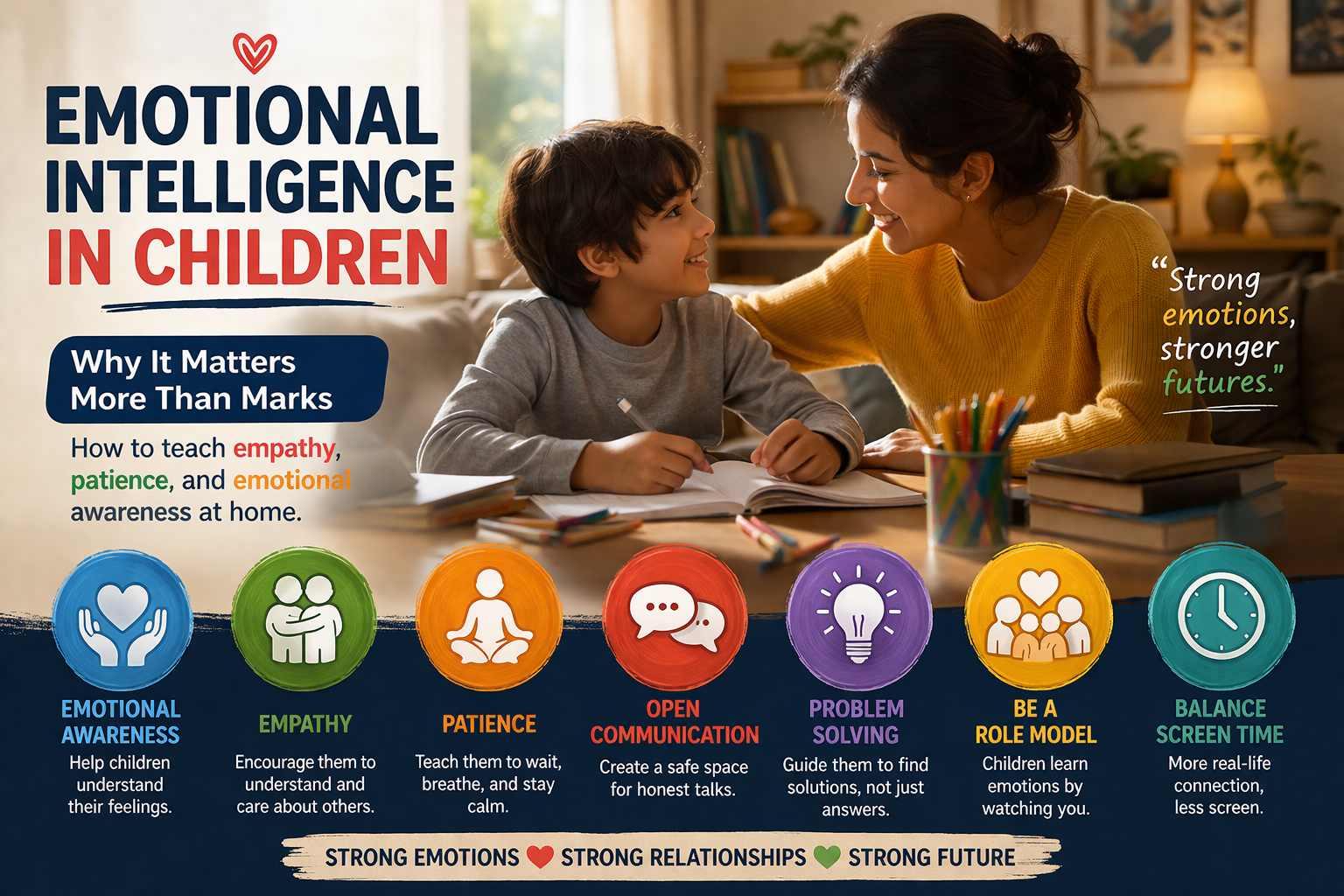
Emotional Intelligence in Children: Why It Matters More Than Marks
How to teach empathy, patience, and emotional awareness at home
Introduction: The Day That Changed Everything
It was a typical evening.
Rohit, a 10-year-old boy, came home from school, quietly placed his bag in the corner, and sat down without saying a word. His mother, busy in the kitchen, noticed something unusual.
“Rohit, how was your test today?” she asked.
He hesitated. “It was okay.”
Later that night, she checked his bag and found the test paper—95 out of 100.
Relieved, she smiled. “That’s great! Why didn’t you tell me?”
Rohit looked down and said something that stayed with her forever:
“Mamma… my friend Aarav got only 60. Everyone was laughing at him. I didn’t feel happy.”
In that moment, it wasn’t the marks that mattered.
It was empathy.
That quiet discomfort Rohit felt—that was emotional intelligence in action.
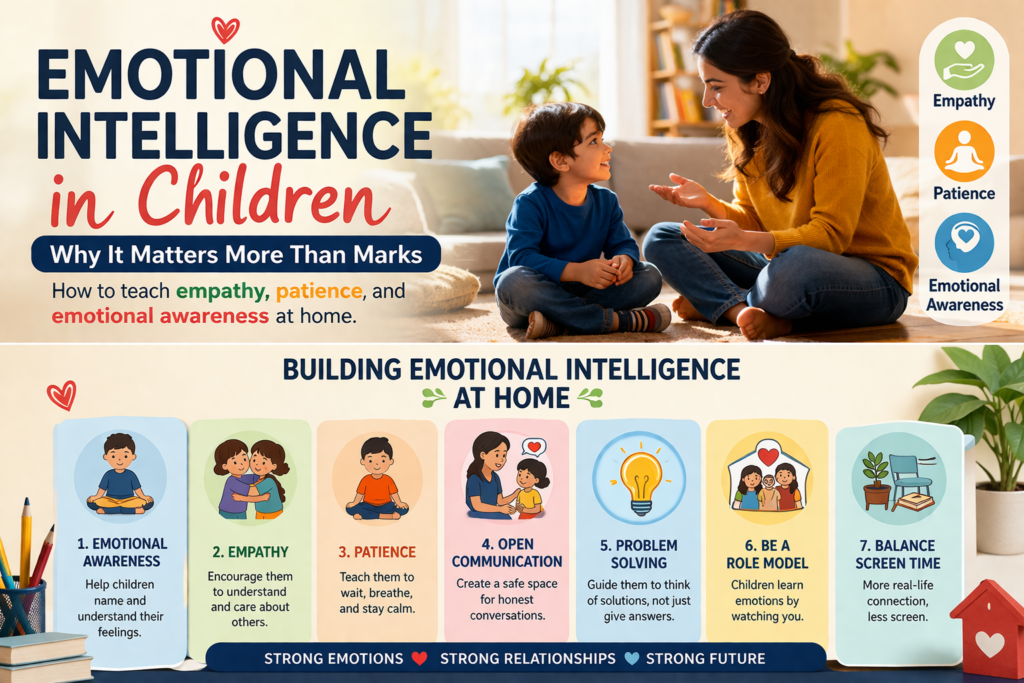
What is Emotional Intelligence (EI)?
Emotional Intelligence is not about being “emotional.” It’s about being aware, balanced, and thoughtful with emotions.
It includes:
- Understanding your own feelings
- Managing reactions
- Recognizing others’ emotions
- Responding with empathy
- Building meaningful relationships
A child with high emotional intelligence may not always top the class—but they will:
- Handle failure better
- Build deeper friendships
- Stay mentally strong
Why Emotional Intelligence Matters More Than Marks
1. Because Life Doesn’t Give Report Cards
In school, answers are either right or wrong.
In life, situations are messy.
Let’s take another story.
🌱 Story: Two Classmates, Two Paths
Ananya and Meera were classmates.
Ananya was always the topper—perfect scores, neat notebooks, disciplined routine.
Meera was average in studies but had something different—she was kind, patient, and always there for others.
Years later:
- Ananya struggled with workplace stress. Small failures affected her deeply. She found it hard to accept criticism.
- Meera, on the other hand, built strong relationships at work. She handled pressure calmly and became a team leader.
Same school. Different life outcomes.
The difference?
Emotional intelligence.
2. Because Relationships Define Success
No matter what career your child chooses, success depends on people:
- Friends
- Teachers
- Colleagues
- Family
A child who understands emotions:
- Resolves conflicts
- Communicates clearly
- Builds trust
Marks don’t teach that.
3. Because Mental Health is the Real Foundation
Today’s children face:
- Comparison
- Social media pressure
- Academic stress
Without emotional skills, they:
- Suppress feelings
- Develop anxiety
- Struggle silently
Emotionally intelligent children:
- Express their feelings
- Seek help when needed
- Stay balanced
4. Because Failure is Inevitable
No child can score 100 in every exam of life.
But how they handle failure matters more than the failure itself.
Emotionally strong children:
- Learn from mistakes
- Don’t fear trying again
- Stay motivated
The Hidden Parenting Trap
Most parents unknowingly fall into this pattern:
- “Did you finish your homework?”
- “How many marks did you get?”
- “Why are your marks less than others?”
But rarely:
- “How are you feeling today?”
- “Did something upset you?”
- “What made you happy?”
Over time, children learn:
Marks matter. Feelings don’t.
And that’s where the gap begins.
How to Teach Emotional Intelligence at Home (With Real-Life Examples)
1. Teach Children to Name Their Emotions
🌱 Story Moment
Six-year-old Kavya threw her toys across the room.
Her father shouted, “Why are you behaving like this?”
She cried louder.
Her mother came, sat beside her, and gently said:
“Are you feeling angry because your game didn’t work?”
Kavya nodded.
That one sentence changed everything.
Why This Works
When children can name emotions:
- “I’m angry”
- “I’m sad”
- “I’m scared”
They feel understood. And emotions become less overwhelming.
2. Accept Emotions, Correct Behavior
Many parents confuse emotions with behavior.
Wrong approach:
“Don’t be angry!”
Better approach:
“It’s okay to feel angry, but it’s not okay to throw things.”
This teaches control without suppressing feelings.
3. Build Empathy Through Daily Conversations
🌱 Story Moment
One day, Riya refused to share her crayons.
Instead of forcing her, her father asked:
“How would you feel if your friend didn’t share with you?”
She paused.
“That wouldn’t feel good.”
That moment planted empathy.
Practical Tips
- Ask reflective questions
- Discuss real-life situations
- Talk about feelings of others
Empathy grows through awareness, not force.
4. Be the Role Model They Watch
Children observe more than they listen.
🌱 Story Moment
A father came home tired and frustrated. Instead of shouting, he said:
“I had a stressful day. I need 10 minutes to relax.”
His child learned:
- It’s okay to feel stressed
- It’s okay to pause
That’s emotional intelligence in action.
5. Teach Patience in Small Ways
We live in a world of instant results:
- Instant videos
- Instant replies
- Instant rewards
Children are losing patience.
🌱 Story Moment
A child kept asking, “When will we reach?”
Instead of irritation, the parent said:
“Let’s play a game while we wait.”
Waiting became enjoyable.
How to Build Patience
- Delay rewards
- Encourage slow activities (drawing, puzzles)
- Appreciate effort, not speed
6. Create a Safe Space for Expression
Children open up only when they feel safe.
🌱 Story Moment
A boy came home upset but said nothing.
Instead of questioning repeatedly, his mother said:
“I’m here when you feel like talking.”
Later that night, he opened up.
Key Lesson
Sometimes silence + presence = trust.
7. Teach Problem-Solving Instead of Giving Solutions
When children face problems, we rush to fix them.
But growth happens when they think.
Try this:
- “What do you think you can do?”
- “What are your options?”
This builds confidence and independence.
8. Reduce Screen Time, Increase Real Connection
Screens replace conversations.
And without conversations, emotional skills don’t develop.
Replace with:
- Family discussions
- Storytelling
- Outdoor play
- Shared meals
Connection builds emotional intelligence.
9. Practice Mindfulness Together
Even 5 minutes daily can help children:
- Stay calm
- Focus better
- Understand emotions
Simple activities:
- Deep breathing
- Gratitude sharing
- Quiet sitting
Common Parenting Mistakes to Avoid
❌ Ignoring feelings
❌ Saying “Don’t cry”
❌ Comparing with others
❌ Overreacting
❌ Focusing only on marks
A Powerful Reflection for Parents
Ask yourself honestly:
- Does my child feel safe sharing emotions with me?
- Do I listen without judging?
- Do I react or respond?
Because…
Children may forget what you taught them, but they will never forget how you made them feel.
Final Story: The Real Report Card
Years later, Rohit (from the beginning story) grew up.
He didn’t always come first in exams.
But he:
- Helped his friends
- Stayed calm under pressure
- Built meaningful relationships
At his workplace, he became someone people trusted—not because of marks, but because of who he was.
One day, his mother asked:
“Do you ever feel bad that you weren’t always the topper?”
Rohit smiled:
“No, Mamma. You taught me something more important—how to understand people.”
Conclusion: Raise a Human, Not Just a Topper
Marks will matter—for a while.
But emotional intelligence will matter—for life.
When you teach your child:
- Empathy
- Patience
- Emotional awareness
You are giving them tools that no exam can measure.
So next time your child comes to you—with tears, anger, or confusion—
Pause.
Listen.
Connect.
Because in that moment, you are not just parenting…
You are shaping a human being.