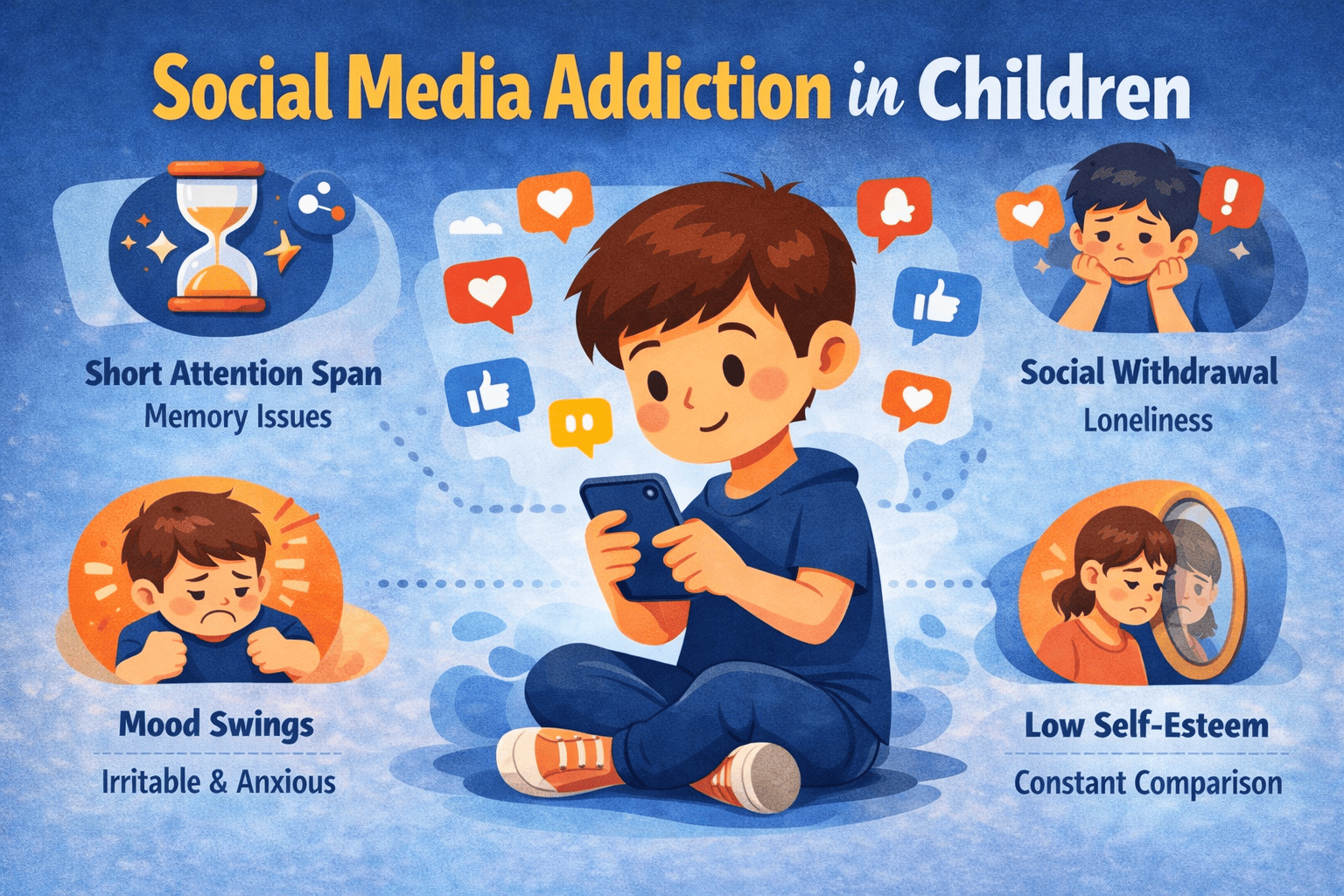
📱 Social Media Addiction in Children: A Deep Theoretical and Practical Understanding
(Expanding Beyond Observation into Psychology, Behavior, and Brain Science)
Childhood today is undergoing a silent transformation. The shift is not just technological—it is psychological, behavioral, and developmental. Social media is no longer an external influence; it has become a primary environment of socialization, shaping how children think, feel, behave, and relate to the world.
To truly understand the impact of social media addiction on children, we must move beyond surface-level observations and explore the theoretical foundations that explain why and how these changes occur.
This article dives deep into the psychology, neuroscience, behavioral theories, and developmental frameworks that explain the growing concern of social media addiction among children.
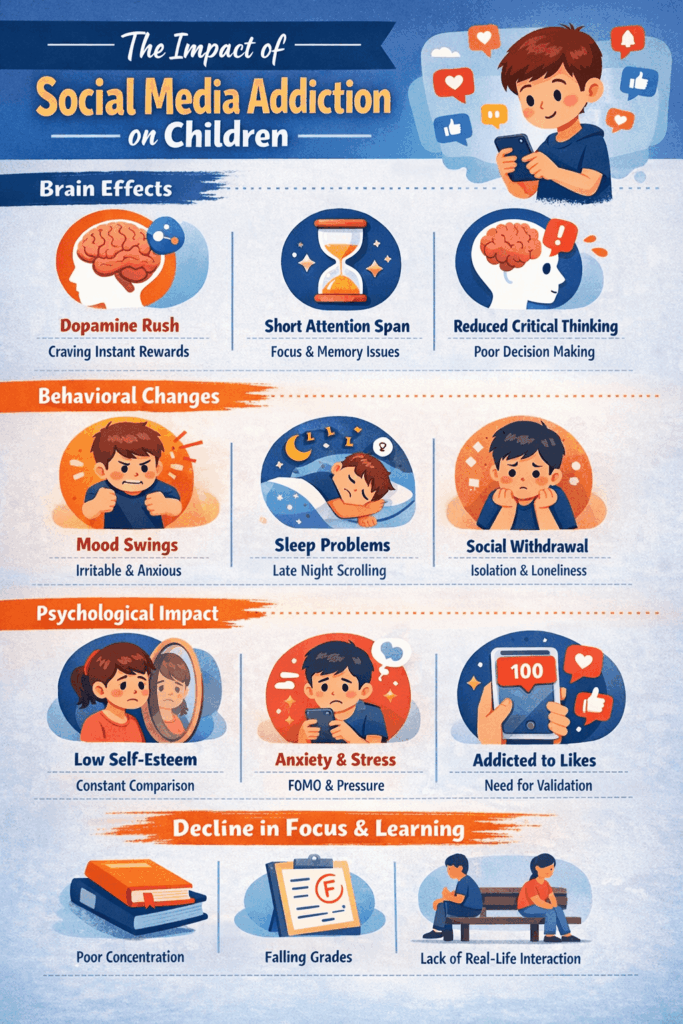
🧠 1. Theoretical Foundation: Why Children Are More Vulnerable
Children are not just “small adults.” Their brains, emotions, and cognitive systems are still evolving. This makes them highly sensitive to environmental stimuli, especially digital ones.
🔬 1.1 Neurodevelopmental Perspective
The human brain develops in stages, and during childhood:
- The prefrontal cortex (responsible for decision-making, impulse control, and focus) is underdeveloped
- The limbic system (responsible for emotions and reward) is highly active
👉 This imbalance creates a situation where:
- Children seek pleasure quickly
- But lack control over impulses
Social media platforms exploit this neurological gap by offering:
- Instant rewards (likes, shares, comments)
- Endless novelty (scrolling content)
This leads to habit formation turning into dependency.
🧪 1.2 Dopamine Reward System Theory
From a neuroscience perspective, social media addiction is closely linked to the dopamine reward pathway.
Every time a child:
- Receives a like
- Watches an engaging video
- Gets a notification
the brain releases dopamine.
👉 Over time:
- The brain starts associating happiness with screen interaction
- Natural rewards (play, study, family time) feel less stimulating
This is known as reward system hijacking.
🧩 2. Behavioral Theories Explaining Addiction
To understand addiction deeply, psychology provides several frameworks:
🔁 2.1 Operant Conditioning (B.F. Skinner)
Social media operates on a variable reward schedule, similar to gambling.
👉 Children do not know:
- When they will get likes
- What content will entertain them next
This unpredictability creates:
- Repeated checking behavior
- Compulsive scrolling
This is called intermittent reinforcement, one of the strongest ways to build habits.
👁️ 2.2 Social Learning Theory (Albert Bandura)
Children learn by observing and imitating others.
On social media, they constantly see:
- Influencers
- Peers
- Celebrities
👉 They begin to:
- Copy behaviors
- Adopt trends
- Seek similar validation
This leads to:
- Identity confusion
- External validation dependency
🪞 2.3 Social Comparison Theory
Children compare themselves with others to evaluate their own worth.
However, social media presents:
- Filtered lives
- Edited beauty standards
- Highlight reels
👉 This results in:
- Inferiority feelings
- Low self-esteem
- Dissatisfaction with real life
🎯 3. Cognitive Impact: Focus, Attention, and Learning
One of the most noticeable impacts is on attention and concentration.
⚡ 3.1 Cognitive Load Theory
The brain has limited capacity to process information.
Social media:
- Bombards children with rapid content
- Constantly shifts attention
👉 This leads to:
- Cognitive overload
- Reduced deep thinking ability
⏳ 3.2 Attention Fragmentation Theory
Frequent switching between apps and content trains the brain for:
- Short bursts of attention
- Instant gratification
👉 Result:
- Difficulty in sustained focus
- Poor academic performance
🧠 3.3 Memory and Learning Disruption
Deep learning requires:
- Repetition
- Reflection
- Focus
But social media encourages:
- Quick consumption
- Minimal retention
👉 This weakens:
- Long-term memory
- Analytical thinking
💔 4. Psychological and Emotional Consequences
😟 4.1 Anxiety and Fear of Missing Out (FOMO)
Children feel pressure to stay constantly updated.
👉 Psychological effects:
- Restlessness
- Anxiety
- Fear of exclusion
😞 4.2 Self-Esteem and Identity Crisis
During childhood and adolescence, identity formation is crucial.
Social media disrupts this by:
- Promoting unrealistic standards
- Encouraging external validation
👉 Result:
- Fragile self-image
- Identity confusion
🧍 4.3 Emotional Regulation Issues
Children exposed to excessive screen time often show:
- Low frustration tolerance
- Increased irritability
- Mood swings
This happens because:
- They are not practicing real-world emotional coping
🧑🤝🧑 5. Social Development and Interpersonal Skills
🗣️ 5.1 Reduced Face-to-Face Interaction
Human communication involves:
- Body language
- Tone
- Emotional cues
Social media removes these elements.
👉 Result:
- Poor communication skills
- Reduced empathy
💬 5.2 Shallow Relationships
Online interactions are:
- Fast
- Superficial
👉 Children struggle with:
- Deep emotional connections
- Conflict resolution
⚠️ 6. Behavioral Manifestations of Addiction
From a clinical perspective, social media addiction shows patterns similar to other behavioral addictions.
Key Symptoms:
- Compulsive usage
- Withdrawal symptoms (irritability without phone)
- Loss of control
- Neglect of responsibilities
- Continued use despite negative consequences
🧪 7. Developmental Psychology Perspective
👶 7.1 Early Childhood (3–8 years)
Impact:
- Delayed language development
- Reduced creativity
- Poor attention span
🧑🎓 7.2 Middle Childhood (9–12 years)
Impact:
- Academic decline
- Social comparison begins
- Dependency on entertainment
🧑🦱 7.3 Adolescence (13–18 years)
Impact:
- Identity crisis
- Emotional instability
- Risk-taking behavior
💡 8. Intervention Strategies (Theory-Based Solutions)
❤️ 8.1 Attachment Theory Approach
Children need secure emotional bonding with parents.
👉 Strong attachment reduces:
- Need for digital validation
- Emotional dependency on social media
🎯 8.2 Self-Determination Theory
Children need:
- Autonomy
- Competence
- Relatedness
👉 Provide:
- Meaningful activities
- Skill-building opportunities
- Real-life social connections
🧠 8.3 Cognitive Behavioral Approach
Help children:
- Recognize unhealthy patterns
- Replace them with positive habits
Example:
- Replace scrolling with reading or sports
📏 8.4 Behavioral Regulation Techniques
- Set structured routines
- Use screen time limits
- Introduce digital detox periods
🌱 9. Role of Parents: A Scientific and Emotional Balance
Parents must act as:
👀 Observers
Understand behavioral changes
🧭 Guides
Provide direction without force
❤️ Emotional Anchors
Offer safety and acceptance
✨ 10. Conclusion: Towards Conscious Digital Parenting
Social media addiction is not just a habit—it is a multidimensional developmental challenge involving:
- Brain chemistry
- Behavioral conditioning
- Emotional needs
- Social influences
Understanding the theoretical foundations helps us respond not with fear, but with clarity and strategy.
Children do not need complete restriction—they need guided exposure.
🌟 Final Thought
“The goal is not to raise children who are disconnected from technology,
but children who are psychologically strong enough to use it wisely.”